


From Survival to Thriving: How Polyvagal Theory Transforms Trauma Recovery

Updated: Mar 6, 2025
When we experience trauma, our nervous system plays a crucial role in how we respond and recover. Polyvagal Theory helps us understand why we react the way we do and offers a roadmap for healing. By learning about this theory, you can gain insight into your own nervous system and discover ways to regulate your emotions and feel safer in your body.
In this way, the foundation of healing lies in creating a sense of safety. As Dr. Stephen Porges, the creator of the theory explains, "Safety is the treatment," meaning that when we feel safe, our nervous system is able shift out of survival mode and into connection and healing.
What is the Polyvagal Theory?
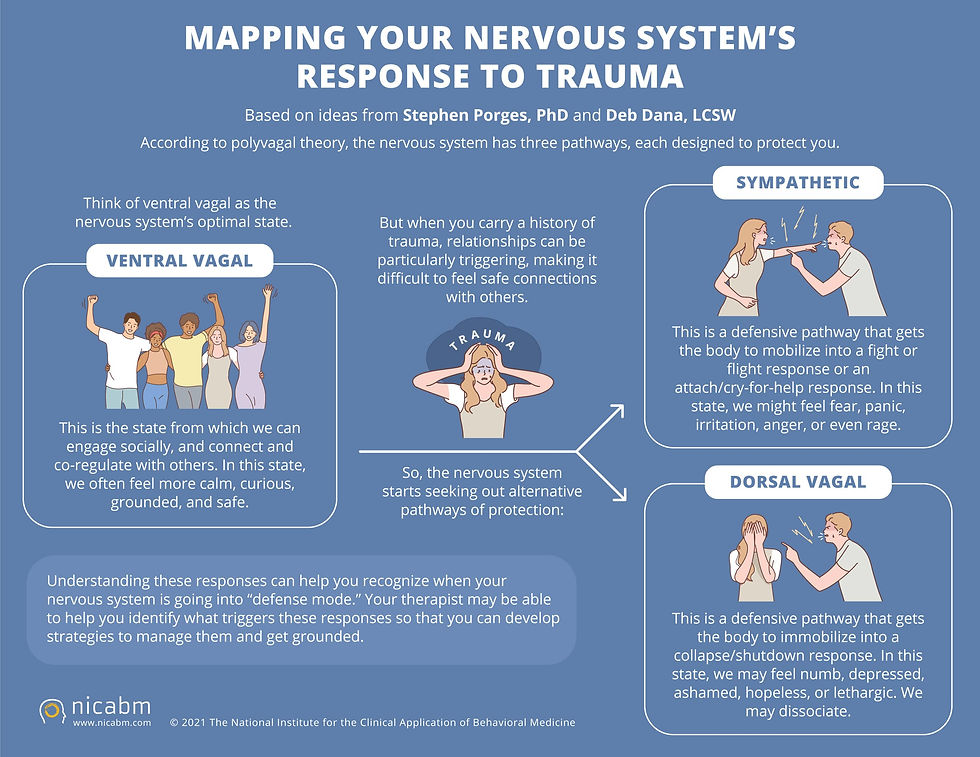
Polyvagal Theory explains how our autonomic nervous system (ANS) controls our responses to safety and danger. The ANS has three main states that describe the relationship between the polyvagal theory and trauma:
Ventral Vagal (Safe & Connected) – When we feel safe, we engage in relationships, experience joy, and think clearly. Our body is in a calm, regulated state.
Sympathetic (Fight or Flight) – When we sense danger, our body mobilises energy to either fight the threat or escape. This can lead to anxiety, hypervigilance, and restlessness.
Dorsal Vagal (Shutdown & Freeze) – If the threat feels overwhelming or inescapable, we may shut down, disconnect, or feel numb and hopeless.
These states are automatic responses designed to keep us safe, but trauma can cause our nervous system to get stuck in survival modes, making it difficult to feel calm or connected.

How we use the Polyvagal theory in trauma therapy to facilitate healing
“Trauma is not what happens to us, but what we hold inside in the absence of an empathetic witness.” – Dr. Peter Levine
In therapy, we use Polyvagal-informed techniques to help retrain your nervous system. This may include grounding exercises, guided breathwork, mindfulness, and movement-based interventions to support a sense of safety and control. Over time, this will help you to learn to navigate your nervous system with greater ease, leading to lasting healing and resilience, allowing access to the grounded state required for deeper trauma repair, such as EMDR processing for example.
Understanding your nervous system is empowering. By working with it, rather than against it, you can move from survival to thriving.
If you're curious about how this approach can support your healing, please reach out and begin your journey toward greater safety, connection, and healing.


Comments